
How do I clean my gutters and check my downspouts?
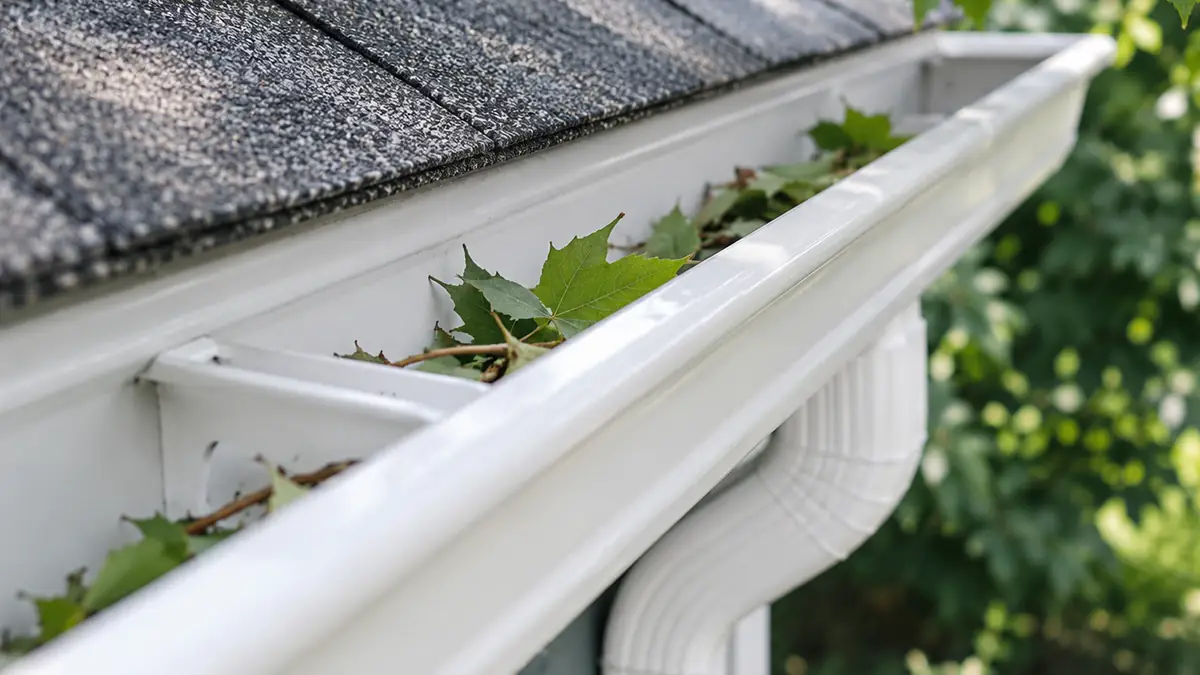
Set a ladder on level ground, scoop out the debris, flush the gutters with a garden hose, and run water through each downspout. Then make sure every downspout empties well away from the foundation. If the roof is too high or too steep to reach safely from a ladder, call a pro.
Quick steps
- Check the weather, the ground and the overhead wires before you set up the ladder.
- Look at the gutters from the ground for cracks, sags and gaps.
- Scoop the debris into a bucket. Start at the corners and work toward the middle.
- Flush each gutter with a garden hose and watch for leaks.
- Run water through every downspout and make sure it flows freely.
- Check that the water runs toward the downspout and that the hangers hold.
- Look at where each downspout lets the water out. It should be well away from the slab.
- Leave roof work to a pro.
The longer version
Gutters have one job. They catch the rain that lands on your roof and carry it somewhere else. When they clog, that rain spills over the edge and lands right beside the house.
Marcus in Garland had a downspout that ended in a little splash block, right beside the slab. NC State Extension says splash blocks let water out too close to the home. So all the rain from that part of the roof landed against the foundation. The fix was an extension that carries the water farther out, and that's what Marcus added.
Why it matters here
Our soil is clay, and clay moves. The Texas Water Development Board describes the Blackland Prairie clays north of Dallas as shrinking and swelling markedly when moisture changes. The engineers at the ASCE Geo-Institute call even moisture the single best thing you can do for a slab. A downspout that dumps water in one spot works against that.
ASCE also says to slope the soil so it drops at least 3 inches over the first 5 feet away from the foundation. A gutter and downspout system works with that slope. It sends the roof's water out to where the ground can take it.
Each step, explained
Set up the ladder safely
Start with the spot you'll put it. The Consumer Product Safety Commission says to use solid, level ground and skip windy days. It also says to assume every overhead wire carries power, and that covers the line from the street to your house. Keep the distance to the nearest line at least twice the length of the ladder. A fiberglass ladder is the safer kind near wires. If you can't keep that distance, skip the job and call a pro.
The American Ladder Institute, which writes the ladder safety standards, tells climbers to keep three points of contact and to face the ladder. Two hands and one foot, or two feet and one hand. It also says to keep your body between the side rails. Don't lean out to reach one more foot of gutter. Climb down and move the ladder.
On an extension ladder, the same group says the base goes about one quarter of the ladder's length out from the wall, and the highest rung you stand on is the third from the top. Have a helper hold the ladder. This Old House also recommends a spotter, along with work gloves and eye protection.
Look from the ground first
Walk the whole house and look up. This Old House says to look for cracks, sags and gaps before you climb. A gap between the gutter and the board behind it, the fascia, is worth a closer look, because a hanger may have let go. Hangers are the little brackets that hold the gutter to the roof edge. If a repair looks bigger than a quick fix, call a gutter pro.
Scoop and flush
Clear the debris with your hand or a scoop and drop it in a bucket, not on the ground. This Old House says that cuts the slipping hazard. Start at the corners and work toward the middle. That way the muck doesn't wash into the downspout.
Here's a grandpa trick from the same article. Cut a scoop from an empty plastic milk jug. It fits the gutter and costs nothing.
Next, flush the gutter with a garden hose and a spray nozzle. A pressure washer isn't needed. Watch for water leaking at the seams, because that points to a failing seal or a hidden crack. Coil the hose before you move the ladder.
Run water through the downspouts
A downspout is the pipe that carries the water down from the gutter to the ground. Put the hose in the top and have a helper watch the bottom. If the water runs clear and fast, you're done. This Old House says to keep flushing when it comes out dirty or slow. If a clog sticks around, take the downspout loose and tap along it. A tinny sound turns to a dull thud where the clog sits. A plumber's snake handles the stubborn ones.
Check the slope
Gutters need a slight tilt toward the downspout. The Department of Energy's Building America Solution Center says a gutter should slope at least 1/16 inch per foot. That's a tiny tilt you can't see by eye. Pour water in and watch where it heads. It should run to the downspout and not sit in one spot.
Send the water away from the slab
Look where each downspout lets the water out. The experts disagree on how far it should reach. ASCE says at least 3 feet from the foundation. The Department of Energy says at least 5 feet, or 10 feet if the water goes into an underground pipe. NC State Extension says to carry it at least 10 feet downhill and away. If your yard has room, reach for the longer numbers.
What people get wrong
Muck tossed on the ground becomes a slipping hazard, so use a bucket.
Leaning far out from the ladder to save a few minutes is a bad trade. Climb down and move the ladder instead.
A clean gutter is only half the job. A clean gutter feeding a clogged pipe still overflows, so run water through each one.
A splash block or a short downspout right at the slab keeps water close to the house. Add an extension or move the outlet farther out, with the distances above as your guide.
ENERGY STAR notes that clogged gutters can overflow and damage a home. When you see water spilling over the edge during rain, that's your sign that a gutter needs attention. I'll remind you when it's time.
When to call a pro
Roof work always goes to a pro. Never step onto the roof to reach the gutters.
Call a pro when the gutter edge is too high to reach from a ladder on level ground, or the roof is steep enough that you'd worry about standing on it. This Old House says to bring in professionals for multi-story homes and for big clogs. It gives no exact height or pitch, so go by your own comfort. If it feels shaky, hire the job out.
Also call a pro if you can't keep the ladder twice its length away from the power lines, or when the gutters sag, pull away from the house, or leak along most of a run.
Sources
- U.S. Consumer Product Safety Commission, Ladders and Electricity Don't Mix. Checked Nov 20, 2026.
- American Ladder Institute via the ANSI Blog, Don't Ignore These Basic Rules of Ladder Climbing. Checked Nov 20, 2026.
- American Ladder Institute via the ANSI Blog, Ladder Safety Tips: Single and Extension Ladders. Checked Nov 20, 2026.
- This Old House, How To Clean Your Gutters (updated May 27, 2026). Checked Nov 20, 2026.
- U.S. Department of Energy Building America Solution Center, Gutters and Downspouts (updated Sep 26, 2021). Checked Nov 20, 2026.
- NC State Extension, Moisture Control and Prevention: Gutter Management (Apr 20, 2022). Checked Nov 20, 2026.
- ASCE Geo-Institute, Living with Shrink-Swell Soils. Checked Nov 20, 2026.
- Texas Water Development Board, Texas state soil page. Checked Nov 20, 2026.
- ENERGY STAR, Homeowner's Guide to Maintaining Your Home. Checked Nov 20, 2026.
I'll remind you when it's time.
Sign up, and I'll send you the job when your house needs it, with a short guide.
Reminders by text and email when your house needs them.
General information only, not a substitute for a licensed pro.